
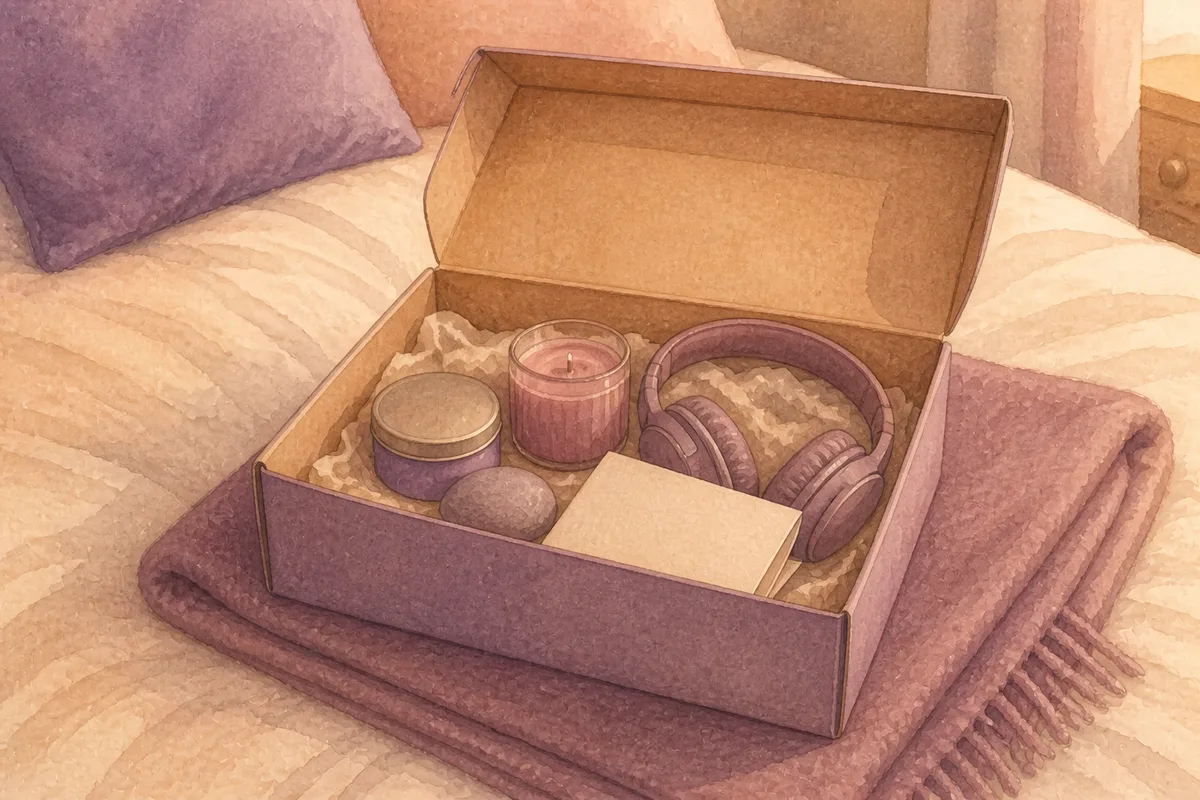
A self-soothe box is a small collection of comforting things, kept together in one place, so that on a hard day you do not have to think about what might help. You open the lid and it is already there.
The idea comes from a set of skills called DBT (dialectical behaviour therapy), where “self-soothe with the five senses” is one of the ways to get through a hard moment without making it worse. Some people call it a calm box, a comfort box or a rainy-day box. The name matters less than having one within reach.
You can make one this afternoon from things already in your home. Nothing needs buying, though a couple of the ideas below cost less than a coffee if you fancy them.
What is a self-soothe box for?
It is for the moments when your nervous system has gone into alarm and your thinking brain has gone quiet. In those moments, trying to remember what usually helps is one job too many. The box does the remembering for you.
It is not there to fix the problem or make the feeling go away. Comfort first, thinking later. If you are a little calmer than you were five minutes ago, it worked.
The idea comes from DBT’s distress-tolerance skills, where “self-soothe with the five senses” is one of the ways to get through a hard moment without making it worse. Around one in five adults in England has anxiety or depression in any given week (Adult Psychiatric Morbidity Survey 2023/24, via Mind), so a box like this is not a strange thing to own. It is a sensible one.
What do you put in a self-soothe box?
One thing per sense is a good place to start. Pick what settles you, not what a magazine says should, and leave out anything that pulls you back into the worry (the phone is the usual one).
- See. A photo of a place or person you love, a postcard, a pressed flower, a colouring page, a small candle you like the look of even unlit. A couple of pages from a magazine that make you feel calm.
- Hear. A note with the name of one song or playlist that helps, so you are not scrolling for it. A small shell to hold to your ear, or a tiny wind-up music box if you have one from years ago.
- Touch. A soft pair of socks, a small fleece square, a smooth pebble from a walk, a hand warmer, a stress ball, a bit of ribbon or velvet. Something your body reads as safe the moment you touch it.
- Smell. A hand cream you like, a lavender bag, a tea bag in a little packet, a bar of soap still wrapped, a dab of a familiar perfume on a cotton pad in a small jar.
- Taste. A mint, a square of chocolate, a sachet of hot chocolate or a favourite tea bag, boiled sweets. Something you enjoy, eaten with attention rather than on autopilot.
Add a few words too: a note from someone who loves you, a line you wrote to yourself on a good day, a list of three people you can text. And something to write or colour with, because writing is one of the fastest ways to give a spinning mind somewhere to put things.
 one comforting thing per sense, kept together
How do you make one with no money?
Go round the house with a bag and collect. Most of the list above is already in a drawer, a bathroom cabinet, or the kitchen. The box itself can be a shoebox, a biscuit tin, an old gift box, a zip-up wash bag or a drawer you empty for the job.
If you want to spend a little, the things that tend to earn their place are a hand cream you like the smell of, a packet of nice tea, and a small set of colouring pencils. Supermarkets, pound shops and chemists cover all three.
Where should you keep it?
Somewhere you will see it on a bad day, without having to go looking. By the bed, on the kitchen side by the kettle, on the arm of the sofa, in the corner you have made a calm corner. If you are out of the house a lot, a smaller version in a pencil case fits in a bag.
When should you open it?
Before you are at your limit, if you can. Try it on a slightly wobbly day first, so your hands learn where things are. Then, when a harder moment comes, opening the box is one small, familiar move rather than a decision you have to make from scratch.
A few good moments to reach for it: when you notice your breathing has gone quick and shallow, after a difficult phone call, in the hour before bed when the thoughts pile up, and any time you catch yourself reaching for the phone, the fridge or the fourth coffee instead. Pick one thing from the box. You do not need all of it, and you do not need to do it well.
If the box does not touch it on a given day, that is not you doing it wrong. It is a harder day. On those days, the kindest thing is often to reach out to someone rather than push through alone.
What goes in mine
For years I made my own journals by hand to get through my own anxiety and low days. The Self-Soothing Journal is that journal, printed properly: the calming skills up front, then space to pour everything out, and it lies flat so you can leave it open.
The other item is on my phone rather than in the box: the Worry Tree, which asks the one question that sorts what I can do something about from what I need to put down for now. It is free, private and works offline.
Keep it easy to keep
Top it up when something runs out, and swap things as the seasons change. A box that has quietly gone stale stops getting opened. Every few weeks, open it on an ordinary day, take out what no longer helps, and put in one new thing.
It is educational self-help, not therapy or medical advice. If today feels heavier than a box of comforts can hold, please talk to someone. The helplines at the bottom of this page are there for exactly that.